In the hotel lobby, my sister and I walk towards the concierge and ask him to translate for us, into Thai script, the names of places we want to go to. I feel helpless at this, this lack of knowing Thai with such absoluteness. Afterwards, he gives us a hotel brochure to use as a marker in case we get lost.
The valet hails us a taxi and we get in. It’s our last day in Bangkok, our flight leaves in the evening. We have been in Thailand for eight days. We spent four days in Pattaya. We watched a burlesque show, parasailed and walked down shops beside a beach. It’s morning, the sun shines but it’s slightly cold. The streets are clear, the taxi moves through gracefully. Yesterday, on a night cruise along Chao Phraya River, we saw The Grand Palace lit up in yellow and gold. “You haven’t seen anything,” our guide said of our trip. He told us we needed to come back during the Chinese New Year or for Songkran, the water festival where people splash water on each other to cleanse themselves as a sign of good things to come.
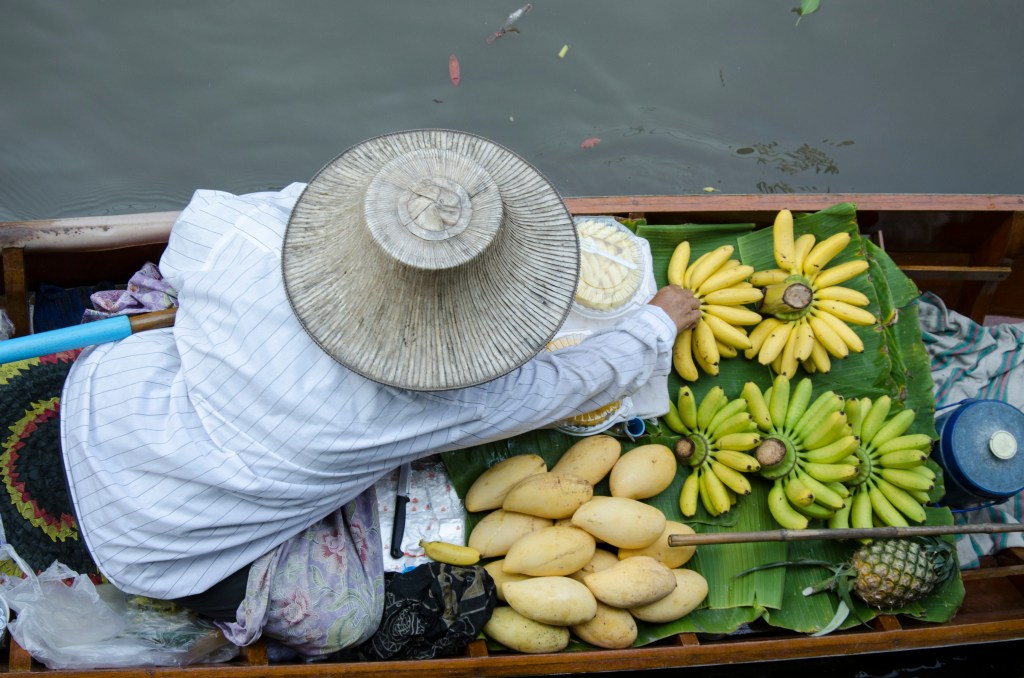
We are going to Taling Chan Floating Market. The taxi is silent, I watch the river outside the window. The streets narrow the farther we go and as we approach the floating market, I see a monk, dressed in an orange robe boarding a bus. The taxi stops, we pay the driver and leave. It strikes me that he hasn’t said a single word to us the whole way. We are met by several stalls. The ones closer to the entrance sell clothes and trinkets. This early, only a few people are walking around. I am wearing a white T-shirt and blue jeans, my sister, a polka dot dress shirt. We are the only black people for miles. The stalls are on either side of what feels like an alley. The ceiling above us is a translucent green, and when light pours through, it feels like we are walking in a green filter. My sister is excited: she takes photographs of everything. We pass through stalls selling fruits, vegetables and flowers. A woman smiles at me when she sees me look at her bonsai plants. As we move deeper into the market, we find more clothes, hats, sandals and bags. There’s a pier where the market meets the river. Here the sellers are in their boats, their wares packed inside. Some shelter from the sun underneath colourful stall umbrellas. The pier has a restaurant on the left side, I watch a woman remove prawns from a cooking pot. Standing on the pier, we seem to float, each step we take, we wobble.
We decide to take a boat ride tour on offer. We pay and wait. We walk into a pavilion where an orchestra performs; in one corner, a barber gives free haircuts. The orchestra plays Thai classical music. We sit and watch. An old woman plays a xylophone, behind her a man plays another xylophone shaped like a boat. A child, a girl with hair held by pink rubber bands, enters. She points to the old man playing the flute and smiles at him. As she walks towards him, her mother rushes out and pulls her away.
It’s eleven and our boat has arrived. Its side is coloured in lines of green, yellow, blue and red. We are twelve of us. My sister and I sit behind a couple with large backpacks. When the boat moves along the river, the green water parts in white arcs. There are houses on either side of the riverbank. The houses are supported by pillars rising from the water. Most of them are quaint and they have potted flowers and plants on the side which faces the river. On the way, we slow down to feed fish with bread. “Bangkok is sinking,” our guide told us on our first day here. Now, I wonder what will happen to all these houses if it does do so. If every memory of them will be completely erased. Halfway, we stop by a small temple for a few minutes and then get back to the floating market. The market is now noisy, bursting with activity. It smells of cinnamon and garlic. People crowd around stalls negotiating prices. I buy a beautiful scarf for a friend. It’s purple and has elephant embroidery. My sister buys one for our mother who is asleep in the hotel.
We decide to visit one more temple: Wat Arun. The sun is scorching when we arrive. I buy for my sister an iced latte for the heat. We are met by a line of worshippers burning incense in one pavilion. Monks are walking around everywhere. We walk towards the central prang, a tall spire that reaches out to the sky in colourful porcelain. Here, we join a line of tourists and pay the entrance. We walk around it, marvelling at its height, at the richly carved designs. I take a photograph of my sister. In this picture she is smiling, her light brown Afro blends with the designs behind her, she’s holding her latte, it’s now half full and above her are the figures of soldiers who seem to be holding up the prang. In another pavilion we see a statue of a reclining Buddha, worshippers bring food and leave it here. As we leave, we find a monk standing in a stall. He asks me if I want to pray.
“Yes,” I reply, although I haven’t prayed in years.
My sister decides not to. First, I donate to the temple. He asks me to follow him.
“What day born?” he asks.
“Tuesday.”
He gives me incense sticks wrapped by a pink cotton paper. Depicted on the paper is the mythology god of Tuesday. The god rides on a bull holding a sword. Swirls of air emanate from the god and the bull. The monk wants to give me instructions, but his English fails him, and I cannot understand Thai.
“He is saying you should take off your shoes,” a woman behind me says. I do so.
“What’s your religion?” she asks.
“I don’t have one.”
She’s the first person I’ve met who is not surprised when I tell her this. Instead, she translates the monk’s instructions. I burn the incense sticks on a candle and plant them into the Tuesday god vase.
“When you pray, ask for anything you want.”
I walk to the carpet. The monk asks me to step back a little. Someone kneels next to me. Incense burns, rising sweetly to my nose. I hold the paper between my hands, bow slightly, and pray.
*This piece was first published in Nomad Magazine in December 2020.
Photo by Stefano Alemani on Unsplash
 Dennis Mugaa